🤖 This English article was translated from the original Japanese with AI assistance. Rules and fares change, so please confirm the latest details on each railway company’s official website before you travel.
※ This page contains promotional (affiliate) links.
Add up the three sides of your suitcase. If the total comes to more than 160 cm, four of Japan’s Shinkansen lines want you to reserve a specific seat before you travel: the Tokaido, Sanyo, Kyushu, and Nishi-Kyushu.
The reservation itself is free. Skipping it is what costs money: board with an oversized bag and no reservation, and a crew member will charge you ¥1,000. On the Tohoku, Hokkaido, Yamagata, Akita, Joetsu, and Hokuriku lines, none of this applies.
That is the whole rule. What follows is how to tell which group your train is in, how to book the seat, and what to do when your bag is simply too big to bring.
The short version
- Measure first. Three sides totaling 160 cm or less, and no oversized-baggage reservation applies to you anywhere in Japan.
- Over 160 cm and up to 250 cm is “oversized baggage.” On the Tokaido, Sanyo, Kyushu, and Nishi-Kyushu Shinkansen, reserve a seat with an oversized baggage area. It is free.
- No reservation means ¥1,000 (tax included), charged on board.
- Over 250 cm cannot be brought on board at all — no fee will fix it. Send it ahead instead.
- The JR East and JR Hokkaido lines work differently: no reservation, no fee, first come, first served.
- What counts as “oversized baggage”
- What it costs: free to reserve, ¥1,000 not to
- Which lines need a reservation — and which do not
- How to reserve a seat with an oversized baggage area
- Two rules that catch travelers out
- When the bag is too big, or you would rather not carry it
- Frequently asked questions
- What does oversized baggage cost on the Shinkansen?
- Which Shinkansen lines require a reservation for large luggage?
- How do I know whether my suitcase counts as oversized baggage?
- Can I bring a large suitcase into a non-reserved car instead?
- Can I reserve one with a Japan Rail Pass?
- How far ahead can I reserve?
- Where in the car is the oversized baggage area?
- What if every oversized baggage seat is taken?
- In short
What counts as “oversized baggage”
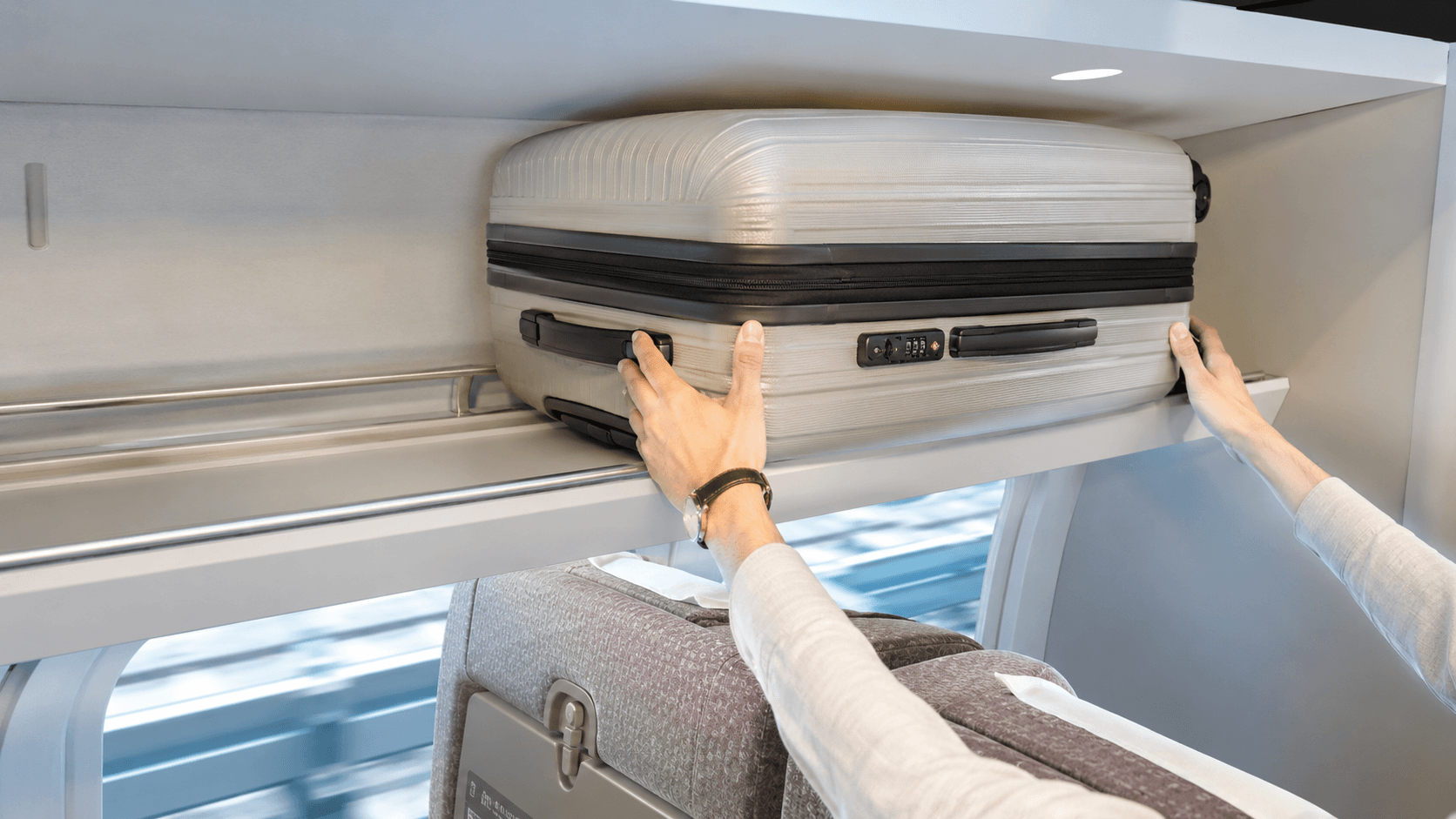
A seat with an oversized baggage area
The threshold is the sum of three dimensions — length plus width plus height — not weight, and not the capacity printed on the label. JR Central defines oversized baggage as “baggage with total dimensions (A+B+C) of between 160 cm (63 inches) and 250 cm (98 inches)”.
Three brackets, three outcomes:
- 160 cm or less: ordinary baggage. Overhead rack, the space at your feet, or an on-board luggage area. No reservation, anywhere.
- Over 160 cm up to 250 cm: oversized baggage. On the four lines listed below, reserve a seat with an oversized baggage area.
- Over 250 cm: not allowed on board. JR Central and JR East both give 250 cm as the ceiling, and paying the fee does not create an exception.
A large or extra-large suitcase can cross 160 cm without looking especially big, which is why the measurement is worth doing before you leave rather than at the gate.
The baseline limits that apply to every bag
Separately from the oversized rule, JR sets general carry-on limits, and JR East’s Oversized Luggage Guide (as of August 2026) puts them plainly.
Three dimensions totaling 250 cm or less. Up to 2 m (about 6.5 ft) long. 30 kg (about 66 lb) or less per item, and up to two items per person.
Usefully, that two-item count excludes “personal items (umbrellas, canes, handbags, etc.)” — so a handbag does not eat into your allowance.
What it costs: free to reserve, ¥1,000 not to
The rule is often described as “the Shinkansen now charges for luggage,” which gets it backwards. Reserving costs nothing. Not reserving is what costs.
- Reserve in advance and there is no extra charge. A seat with an oversized baggage area is priced identically to a regular reserved seat in an ordinary or Green (first-class) car.
- Board without reserving and you pay ¥1,000, tax included (roughly $7 USD or €6 EUR, depending on the day’s exchange rate). A crew member may also move your bag to a different spot.
So the fee is best thought of as the cost of not spending thirty seconds at the ticket counter. And it is worth repeating that a bag over 250 cm cannot be brought aboard whether or not you pay.
Which lines need a reservation — and which do not
This is where most of the confusion lives, because the answer depends on which line you are on rather than on the Shinkansen network as a whole.
| Shinkansen | Main sections | Oversized baggage |
|---|---|---|
| Tokaido, Sanyo, Kyushu, Nishi-Kyushu | Tokyo–Shin-Osaka–Hakata–Kagoshima-Chuo / Takeo-Onsen–Nagasaki | Reservation required for a seat with an oversized baggage area (free). Without one, ¥1,000. |
| Tohoku, Hokkaido, Yamagata, Akita, Joetsu, Hokuriku | Tokyo–Shin-Aomori–Shin-Hakodate-Hokuto / Tokyo–Kanazawa and Tsuruga | No reservation. Use the luggage areas on board, free of charge. |
Each company states it from its own end, and the two agree. The reservation rule covers four lines — Tokaido, Sanyo, Kyushu, and Nishi-Kyushu — and JR Central’s English page sets them out. JR East’s English guide names those same four and sends travelers to the operating company for them, describing its own luggage areas as “available on a first-come, first-served basis.”
A geographical shortcut will mislead you here: the Hokuriku Shinkansen runs west out of Tokyo, but it sits in the no-reservation group. Go by line name, not by direction and not by which company you think runs it.
One more wrinkle on the Tokaido and Sanyo lines. Some decks have an “oversized baggage compartment,” which JR Central currently offers on a trial basis as a storage area that needs no reservation.
It is meant for medium-size luggage. It does not replace the rule: a bag over 160 cm still needs a reserved seat with an oversized baggage area, and the ¥1,000 fee still applies without one. Trials also change, so check before relying on it.
How to reserve a seat with an oversized baggage area
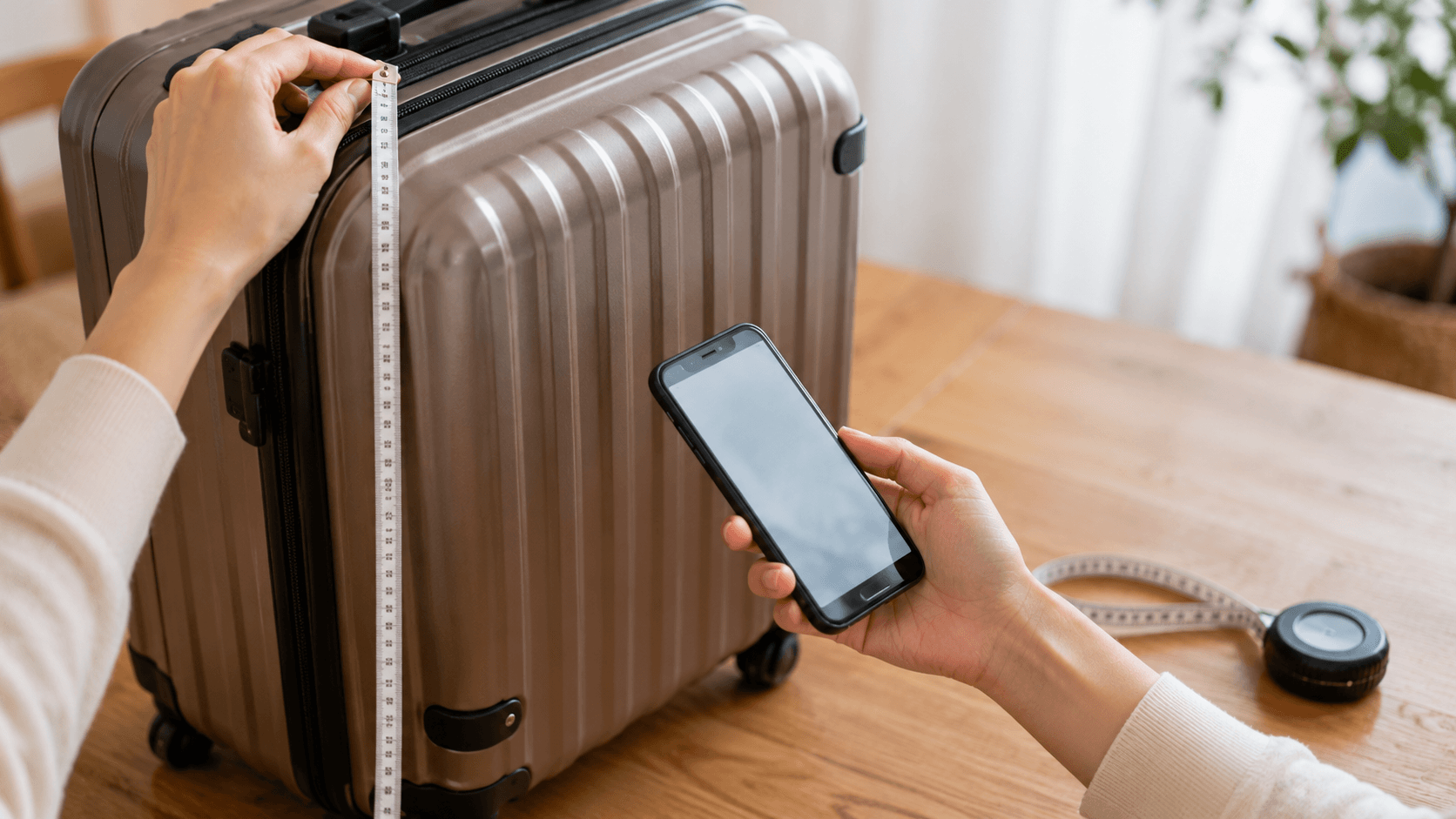
Measure your bag, then reserve
Ask for it when you buy the ticket. JR Central lists the channels:
- A JR ticket office (Midori-no-Madoguchi): tell the staff member you would like a seat with an oversized baggage area. That sentence is enough.
- Reserved-seat ticket machines at JR stations.
- Online: the Tokaido Sanyo Kyushu Shinkansen Online Reservation Service (Smart EX and EX Reservation, as of August 2026), JR-WEST ONLINE TRAIN RESERVATION, or JR-KYUSHU Train Reservation. The seat map marks the relevant seats.
Booking opens one month in advance, the same as any reserved seat. There is no deadline before departure, so a same-day booking works if a seat is left — but only a handful of seats per car carry the space, and they go early around holidays. If you are changing between Shinkansen, each train needs its own reservation.
With a Japan Rail Pass
Yes, and at no extra cost. JR Central states that your seat reservation “will not cost more even if it includes an oversized baggage area.” Arrange it at a JR ticket office, or through the JAPAN RAIL PASS Reservation service, which has handled these seats since June 1, 2020.
The seat itself is always booked with JR — that part cannot be outsourced. But if your route involves several transfers and you would rather have the passes and tickets settled before you land, a travel platform that works in English is one way to do it.
SPONSORED | Rail passes and Shinkansen tickets, booked in English
Klook
A booking platform that handles rail passes, Shinkansen tickets, and airport transfers in English. Worth a look if you would rather sort the whole route before you fly, rather than at a ticket window on the day.
Two rules that catch travelers out
The size threshold is the part everyone reads. These two are the parts people find out about on board.
You cannot take oversized baggage into a non-reserved car. JR Central is explicit that oversized baggage may not be brought into non-reserved cars, or into reserved cars without an oversized baggage area. It is tempting to assume the unreserved cars are a fallback with less space; they are not a fallback at all.
The space behind the seat is shared. The oversized baggage area serves the whole last row, so the passengers who booked those seats fit their bags in together. JR Central asks travelers to make room for one another. Reserving gets you access to the space — not a private compartment.
When the bag is too big, or you would rather not carry it
Over 250 cm, or simply not worth wheeling through Tokyo Station at rush hour? The bag does not have to travel with you.
- Same-day luggage delivery. JR Central points travelers to LUGGAGE EXPRESS, which collects a bag at a hotel or station and delivers it to your next hotel the same day. Private courier services (takkyubin, Japan’s door-to-door delivery networks) cover the same ground.
- Coin lockers and luggage storage. Best for the in-between hours — you have checked out, your train is at 6 PM, and you want the afternoon free.
There is also a category of luggage the rule simply skips. Strollers, wheelchairs, sports equipment, and musical instruments need no reservation and no fee, even when they go past the oversized threshold.
Each of those four carries its own conditions. JR Central gives dimensions for wheelchairs, and asks that sports equipment and instruments be stowed upright. Check the official page if yours is unusually large.
For a stroller, though, there is nothing to arrange. Fold it or don’t, bring it aboard, and this rule never enters the picture.
SPONSORED | Luggage delivery and storage, arranged online
KKday
Alongside rail tickets, KKday lists the services that make a bag disappear for a day: airport-to-hotel delivery and station luggage storage. Useful when your suitcase is over the 250 cm limit, or when you simply do not want to drag it through a transfer.
Frequently asked questions
What does oversized baggage cost on the Shinkansen?
Nothing extra, as long as you reserve. A seat with an oversized baggage area is the same price as any other reserved seat in an ordinary or Green car. The charge only appears if you board with oversized baggage and no reservation: a baggage fee of ¥1,000 including tax (roughly $7 USD or €6 EUR, depending on the exchange rate that day).
Which Shinkansen lines require a reservation for large luggage?
Four of them: the Tokaido, Sanyo, Kyushu, and Nishi-Kyushu (West Kyushu) Shinkansen. On the Tohoku, Hokkaido, Yamagata, Akita, Joetsu, and Hokuriku Shinkansen there is no reservation system for oversized baggage, and the luggage areas on board are free to use. Those areas are first come, first served, so they are not guaranteed.
How do I know whether my suitcase counts as oversized baggage?
Add the three dimensions together: length plus width plus height. Up to 160 cm (about 63 in) and it is ordinary baggage, with no reservation needed anywhere. Between 160 cm and 250 cm (about 98 in) it is oversized baggage, and the four lines above need a reservation. Above 250 cm it cannot be brought on board at all. A tape measure at home settles it in thirty seconds.
Can I bring a large suitcase into a non-reserved car instead?
No. JR Central states that oversized baggage cannot be brought into non-reserved cars, or into reserved cars that have no oversized baggage area. This is the part travelers most often get wrong: the rule is not simply that the unreserved cars lack the space, it is that the baggage is not permitted there.
Can I reserve one with a Japan Rail Pass?
Yes, and it costs nothing extra. In JR Central’s words, your seat reservation “will not cost more even if it includes an oversized baggage area.” Ask at a JR ticket office, or book through the JAPAN RAIL PASS Reservation service, which has handled these seats since June 1, 2020.
How far ahead can I reserve?
Like any other reserved seat, one month in advance. There is no cut-off before departure, so you can still book on the day if seats remain, but the supply is small and holiday periods go early. If your dates are fixed, book as soon as the window opens.
Where in the car is the oversized baggage area?
In the last row of certain cars. Reserve one of those seats and you may use the space behind it for your bag. One thing to expect: the space is shared with the other passengers in that last row, so you are fitting your suitcase in alongside theirs rather than claiming the whole area.
What if every oversized baggage seat is taken?
Three ways out. Shift to an earlier or later train that still has one. Send the bag ahead to your hotel and travel with a day pack. Or measure again — if the three sides come to 160 cm or less, no reservation is required and the problem disappears. Station staff can also suggest alternatives on the spot.
In short
- Measure the three sides. Over 160 cm and up to 250 cm is oversized baggage; over 250 cm cannot board.
- Reserving is free. Not reserving costs ¥1,000, tax included.
- Reservations apply to the Tokaido, Sanyo, Kyushu, and Nishi-Kyushu lines only. The JR East and JR Hokkaido lines are free and need no booking.
- Book at a ticket office, a machine, or online, one month ahead. A Japan Rail Pass reserves one at no extra cost.
- Non-reserved cars are not an option for an oversized bag, and the space behind the seat is shared.
Most travelers only need the first line of that list. Measure the suitcase before you pack it, and either the rule applies to you or it does not — which is a much better thing to discover at home than at Tokyo Station.
Once the luggage is settled, the other thing worth timing is the park itself. Our Tokyo Disneyland crowd calendar and Universal Studios Japan crowd calendar show which days to aim for.
And if you are still working out how to stay online while you are here, our guide to eSIMs and pocket Wi-Fi in Japan covers that before you fly.
You might also like
- Japan eSIM vs Pocket Wi-Fi: How Travelers Stay Online at the Parks — sort your data before you land
- Tokyo Disney Language & App Guide: What to Know Before You Visit — the app does most of the work once you arrive
- Japanese Manners for Theme Parks & Travel: A Visitor’s Guide — including how queues and trains actually work
- All English travel guides and crowd calendars
Tokyo Disney Resort®, Tokyo Disneyland®, and Tokyo DisneySea® are registered trademarks of Oriental Land Co., Ltd. and Disney affiliates. USJ® and Universal Studios Japan® are registered trademarks of NBCUniversal / USJ LLC. This is an independently operated information site and is not an official partner of any of these companies.
※ The images in this article were created using generative AI.